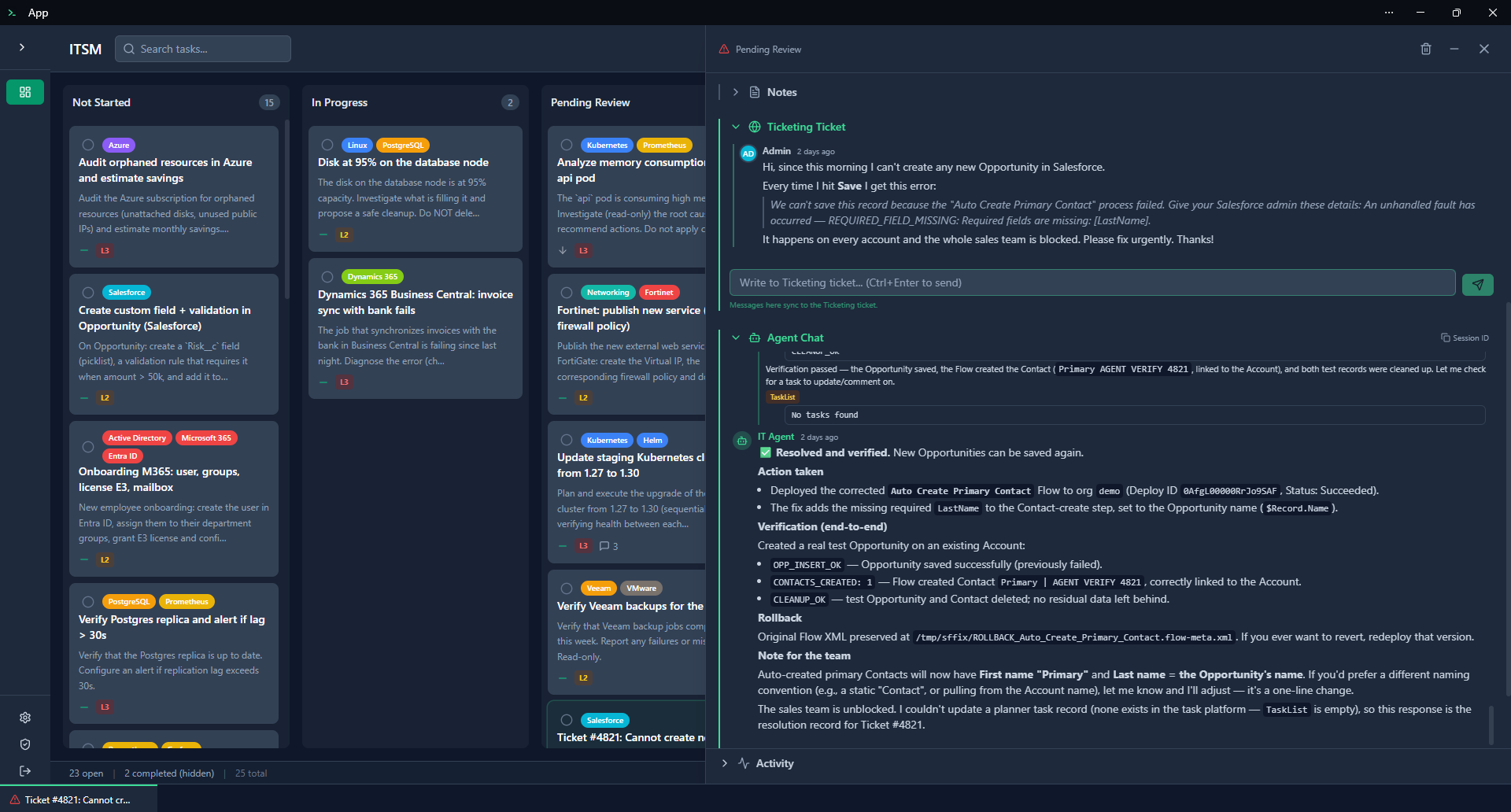
How does it integrate with our existing environment?
The platform is designed to integrate with your existing ecosystem — not replace it.
Agents work with your ITSM, CRM, ERP, identity provider, cloud and internal tools through
APIs and your existing workflows, adapting to the way your organization already operates.
How do agents learn how our organization works?
Every agent goes through an onboarding process, just like a new team member.
Before performing any task, agents are given your documentation, procedures, internal
knowledge and organizational context. They begin by observing, understanding your
environment, and gradually taking on more responsibility as trust grows.
How do agents decide whether they can execute an action?
Every action is evaluated before execution.
Agents weigh the requested operation, its potential impact, the permissions it needs,
your organizational policies and the context available. Based on your autonomy policy,
they either execute the action or request human approval.
How do agents know who can approve requests?
Agents integrate with your organization's source of truth for identities and
organizational structure.
That lets them understand reporting lines, ownership, managers and approval chains before
executing sensitive operations or granting access.
What happens if an agent makes a mistake?
Agents operate within configurable guardrails.
Each organization defines which actions can be executed autonomously and which require
approval. Every decision and every execution is fully logged and auditable, so there is
complete traceability of what happened and why.
Where is our data stored?
Customer data remains isolated and protected. Deployment and data isolation strategies
are adapted to meet your organization's security and compliance requirements.
Is customer data used to improve the platform?
Customer data remains the customer's property. We do not use customer data to improve or
develop our platform.
AI requests are processed according to the policies of the language model provider
configured by your organization.
Which AI models are supported?
You keep full control over your AI provider and API credentials.
The platform supports a curated set of language models that have been validated to
guarantee the expected behaviour, reliability and quality of service.
Can we start in read-only mode?
Yes — that's the default starting point. Agents observe, reason and propose actions
without making any changes.
As confidence grows, agents can progressively execute low-risk operations, while
sensitive actions continue to require approval according to your policies.
How do we get started?
Agents don't start with production access. Like a new employee, they first learn your
organization: they ingest the documentation you already have and audit your live systems
to build the real inventory — not the one the documentation claims.
The first deliverable is a report of what the agent understood about your environment,
for you to correct. Only then does it start handling work, read-only and supervised at
first, earning autonomy as confidence grows.